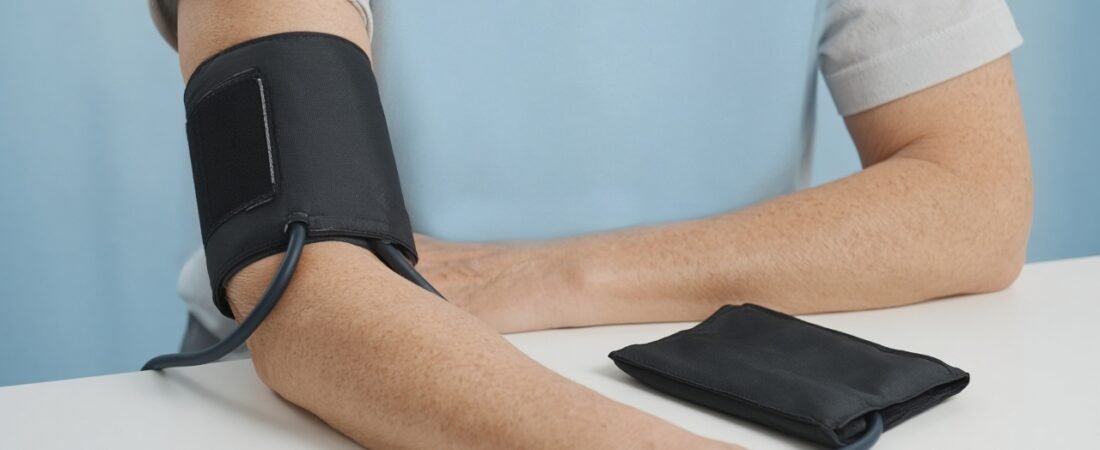
This post contains affiliate links. As an Amazon Associate I earn from qualifying purchases.
Is your blood pressure different in each arm? You check your blood pressure on your right arm: 134/84. Out of curiosity you try your left: 124/80. Is one arm wrong? Is something wrong with you?
A small difference between arms is common and usually harmless. A large difference that shows up again and again, though, is worth a conversation with your doctor. This guide explains what’s normal, why the arms can differ, which arm to use at home, and how to check both arms the right way.
Quick answer: blood pressure different in each arm
It’s normal for blood pressure to differ slightly between your left and right arms. Mayo Clinic says a small difference usually isn’t a concern, but a difference of more than 10 mm Hg can be. Guidelines from the American Heart Association recommend checking both arms at least once, then using the arm with the higher reading from then on. If you repeatedly see a gap of more than 10 mm Hg, tell your healthcare professional.
Looking for an upper-arm monitor that syncs your readings to your phone? Here’s the Oxiline Pressure XS Pro on Amazon.
Is it normal to have different blood pressure in each arm?
Yes, to a point. The American Heart Association tells home users they can use either arm, because there’s usually not a big difference between them.
Larger gaps are less common. The AHA’s scientific statement on blood pressure measurement cites a systematic review of readings taken in both arms at the same time. It found a systolic difference of 10 mm Hg or more in about 11.2% of people with hypertension and about 3.6% of the general population.
What’s a normal difference in blood pressure between arms?
There’s no single cutoff that applies to everyone, but the guidance clusters around 10 mm Hg:
- Under 10 mm Hg: generally not a concern, according to Mayo Clinic.
- More than 10 mm Hg, repeatedly: may be a cause for concern and worth discussing with your doctor. The difference can be in either the top (systolic) or bottom (diastolic) number.
- 10 to 15 mm Hg systolic, over and over: Mayo Clinic notes that people with this pattern are more likely to have vascular disease and have a greater risk of heart disease over time.
The key word is repeatedly. One mismatched pair of readings proves little, because blood pressure changes from minute to minute.
Why would blood pressure be higher in one arm?
Normal variation and measuring one arm after the other
Most home users measure one arm and then the other. Because blood pressure shifts naturally, the second reading can differ just because time has passed. The AHA’s statement points out that if the second arm reads substantially lower, the difference may simply be because you’ve settled in (acclimation), and the first arm should be measured again.
Measurement errors
Different cuff positions, a sleeve under the cuff on one side, or one arm resting lower than the other can create a gap that isn’t real. Using a cuff that’s too small reads high, and too large reads low.
Narrowed or blocked arteries
A persistent, large difference can signal a problem with blood flow. Mayo Clinic lists possible causes including:
- Blocked blood vessels in the arms (peripheral artery disease)
- Atypical connections between blood vessels in the arms (fistulas)
- Patent ductus arteriosus, a persistent opening between two major blood vessels leading from the heart
The AHA statement also notes that a large difference might be caused by coarctation (narrowing) of the aorta or a blockage in an artery to the arm.
Which arm gives the most accurate blood pressure?
The arm with the consistently higher reading. That’s the guidance in the AHA’s measurement statement: record blood pressure in both arms at the first visit, then use the arm with the higher reading for future measurements. Using the lower arm could make your blood pressure look better controlled than it really is.
Canadian guidelines take a similar practical approach for home measurement: use your non-dominant arm unless the systolic difference between arms is more than 10 mm Hg, in which case use the arm with the higher value (Hypertension Canada).
Whichever arm you choose, Mayo Clinic advises always using the same arm, so your readings stay comparable over time.
Left arm vs right arm blood pressure: is one side usually higher?
People often ask whether the right or left arm is “supposed” to be higher. The guidelines don’t name a side. Neither the AHA nor Mayo Clinic tells you to favor the left or the right; they tell you to compare both and use whichever is consistently higher for you. If your right arm always reads a few points higher, that’s simply your pattern.
How to check blood pressure in both arms at home
You don’t need two monitors. A careful routine works:
- Prepare as usual. No caffeine, smoking, or exercise for 30 minutes; empty your bladder (CDC).
- Sit correctly. Back supported, feet flat, legs uncrossed. Rest for 5 minutes.
- Measure the first arm with the cuff on bare skin at heart level.
- Move the cuff to the other arm and measure again, about a minute later, with the arm supported at the same height.
- Measure the first arm again. This helps account for the “settling in” effect described by the AHA.
- Repeat on a few different days and write down which arm each reading came from.
- Compare the patterns. If one arm is consistently higher, use it going forward. If the gap is repeatedly more than 10 mm Hg, share your log with your doctor.
Your doctor may confirm a difference by measuring both arms at the same time with two devices, which removes the effect of time between readings.
A validated, upper-arm monitor with the right cuff size makes this much more reliable. If you’re not sure your device is up to the job, see how to check if your blood pressure monitor is accurate or browse our picks for the most accurate blood pressure monitor brands.
When to see a doctor about an arm difference
Make an appointment if:
- You repeatedly see a difference of more than 10 mm Hg between arms.
- One arm also feels cold, weak, numb, or tires easily with use.
- You have known heart or vascular disease, diabetes, or high blood pressure, and you notice a new difference.
Call 911 if a reading is above 180/120 mm Hg and you have symptoms such as chest pain, shortness of breath, back pain, numbness, weakness, vision changes, or difficulty speaking, which the AHA lists as signs of a hypertensive emergency. Also seek emergency care for any sudden, severe chest or back pain, whatever the reading.
Blood pressure different in each arm: frequently asked questions
Is it normal for my blood pressure to be different in both arms?
Yes. A small difference is common and usually not a concern. A difference of more than 10 mm Hg that shows up repeatedly is worth discussing with your healthcare professional.
Why is my blood pressure always higher in my right arm?
For many people, one arm simply reads a bit higher. That’s your normal pattern, and guidelines say to use the higher arm for future readings. If the right arm is more than 10 mm Hg higher again and again, ask your doctor whether further checks are needed.
Which arm should I use for blood pressure at home?
Check both arms on a few occasions. Then use the arm that’s consistently higher, and stick with it. If the two arms are about the same, Canadian guidelines suggest your non-dominant arm.
Is a 20-point difference in blood pressure between arms dangerous?
A repeated difference that large is above the 10 mm Hg threshold that Mayo Clinic says can be a concern, and can point to a problem with blood flow. It isn’t a diagnosis on its own, but you should see your doctor to confirm it with proper measurements. Seek emergency care if it comes with symptoms like chest pain, weakness, or numbness.
Does the arm I use change my blood pressure diagnosis?
It can. The AHA recommends using the higher arm for ongoing readings, because relying on the lower arm could underestimate your blood pressure.
Sources
- Mayo Clinic. Blood pressure: Can it be higher in one arm? https://www.mayoclinic.org/diseases-conditions/high-blood-pressure/expert-answers/blood-pressure/faq-20058230
- Mayo Clinic. Get the most out of home blood pressure monitoring. https://www.mayoclinic.org/diseases-conditions/high-blood-pressure/in-depth/high-blood-pressure/art-20047889
- Muntner P, et al. Measurement of Blood Pressure in Humans: A Scientific Statement From the AHA (NIH PMC). https://pmc.ncbi.nlm.nih.gov/articles/PMC11409525/
- American Heart Association. Home Blood Pressure Monitoring. https://www.heart.org/en/health-topics/high-blood-pressure/understanding-blood-pressure-readings/monitoring-your-blood-pressure-at-home
- CDC. Measuring Your Blood Pressure. https://www.cdc.gov/high-blood-pressure/measure/
- Hypertension Canada. Supplementary Tables (Recommended technique for home BP measurement). https://hypertension.ca/guidelines/supplementary-tables/
Medical disclaimer
This article is for general information only and is not medical advice. It does not replace diagnosis or treatment from a qualified healthcare professional. A difference in blood pressure between arms can have many causes, and only a clinician can evaluate it. If your blood pressure is higher than 180/120 mm Hg and you have symptoms such as chest pain, shortness of breath, back pain, numbness, weakness, vision changes, or difficulty speaking, call 911.