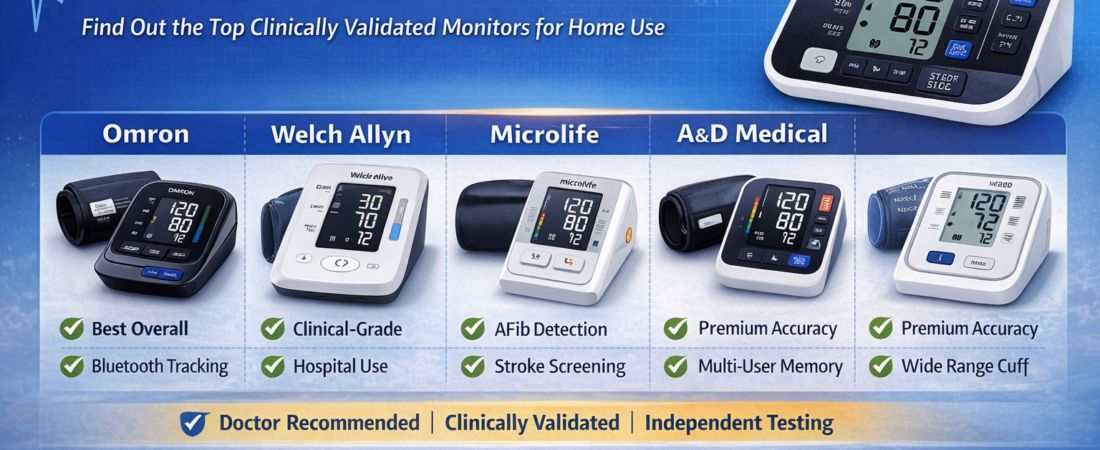
20 Most Accurate Blood Pressure Monitor Brands and Models Based on 2025 Testing
These validated home monitors deliver clinical-grade readings backed by independent testing and expert reviews.
If you track your blood pressure at home, you may be more likely to catch dangerous spikes before they escalate into emergencies when you use a clinically validated watch that matches the accuracy of equipment in your doctors office.
This matters because undetected high blood pressure silently damages your heart and arteries for years before symptoms appear. The American Medical Association has validated over 200 devices through 2025, so accurate options exist now.
Interestingly, when you check readings twice daily, patterns emerge faster. But its much harder choosing reliable watches, even from major brands.
So its really important to verify clinical validation before buying, especially when managing medication or chronic conditions.
Also don’t forget that cuff size affects accuracy more than brand name recognition.
You may even get different readings from a validated device if the cuff doesn’t fit properly.
To avoid wasting money on inaccurate watches, you should check validatebp.org before purchasing any model.
Typically drugstore brands skip independent validation testing. This leaves you guessing whether readings reflect your actual blood pressure.
And it can be more difficult for you if you have larger arms or irregular heartbeats, because standard cuffs and basic sensors miss important details. But specialized validated monitors handle these situations.
You might also sometimes see readings vary by 10-15 points between devices. Just compare your new watch against your doctors equipment during your next visit to confirm accuracy.
Of course, your health decisions depend on trustworthy numbers from home monitoring.
Upper-Arm Monitors with Strong Validation Scores
1. AandD Medical Premium Multi-User
This model performed exceptionally well in every accuracy test AARP conducted in 2025, matching clinical equipment within 2 mmHg consistently. The wide-range cuff accommodates arms from 8.6 to 16.5 inches, and the multi-user memory stores separate readings for different family members.
Testers praised how it detected irregular heartbeats without false alarms, and the large display makes numbers easy to read even in dim lighting.
You won’t find glitches or calibration drift with this one. Costs around $70 at major retailers.
2. Omron 3 Series Upper Arm (BP7100 or BP7150)
Consumer Reports and AARP both gave this budget champion top accuracy ratings despite costing $20 less than comparable models. The simple one-touch operation means you just press a button and wait for results.
The D-ring cuff design makes wrapping easier than traditional styles, fitting arms 9 to 17 inches comfortably.
Memory stores up to 14 readings, which covers two weeks of daily checks. The irregular heartbeat indicator lights up when it detects arrhythmias, prompting you to ask your doctor.
3. Omron Evolv BP7000
Consumer Reports named this their top pick for 2025-2026 because the all-in-one design eliminates tubes that tangle or break. The watch builds directly into the cuff, creating a sleek unit perfect for travel or small spaces.
Bluetooth syncs automatically with the Omron Connect app, tracking trends over months.
Testing showed it matched mercury sphygmomanometers within 1.5 mmHg on average. The wrap does need practice to position correctly at heart level, but comfort scores were excellent once users learned the technique.
Priced between $80 and $90.
4. AandD Medical UA767F
Another Consumer Reports favorite, this model excels at averaging many readings to smooth out normal variations between measurements. The irregular heartbeat detector caught atrial fibrillation patterns in validation studies.
The cuff fits arms 8.6 to 16.5 inches and includes a helpful artery marker showing exactly where to position it.
Two-user memory separates readings for couples sharing one device. Users mention the self-wrap cuff sometimes needs adjustment for proper snugness, but accuracy stays solid at around $50.
5. AandD Medical UA-787EJ
High marks for accuracy from Consumer Reports testing, plus exceptional comfort ratings thanks to the molded cuff design. The single-user memory stores enough readings for monthly trend analysis.
The cuff handles 9 to 17 inch arms easily.
Some testers found the loose fit required checking placement more carefully than stiffer cuffs. The irregular heartbeat detection works consistently, and risk category indicators color-code whether readings fall in healthy ranges.
Solid daily-use watch for about $60.
Budget Options Under $50
6. IHealth KN550BT
Consumer Reports gave this budget model the same accuracy scores as monitors costing twice as much. The large backlit display shows systolic, diastolic, and pulse numbers clearly.
Bluetooth connectivity sends readings to your smartphone for easy sharing with doctors.
The averaging feature calculates mean values from recent measurements, following clinical guidelines. Irregular beat detection alerts you to rhythm problems.
The cuff fits 8.7 to 16.5 inch arms.
Often available for under $50, making it the best value for tech-savvy users wanting app integration without premium pricing.
7. ReliOn BP300
Walmarts house brand earned validation from the American Medical Association, proving store brands can match name-brand accuracy when properly tested. This basic upper-arm model handles essential measurements without fancy features, keeping the price around $35. The cuff accommodates standard arm sizes, and the simple display shows readings without confusing icons.
Memory stores recent checks for comparison.
Perfect for anyone wanting reliable numbers without smartphone connectivity or advanced tracking.
Premium Smart Monitors
8. Oxiline Pressure XS Pro
The National Council on Aging named this their best overall pick for 2025-2026 because the VIBRA™ TX Sensor technology improves accuracy during measurement motion. Bluetooth shares data with the companion app, generating charts and reports you can email directly to your healthcare provider.
The adjustable cuff fits 8.7 to 16.5 inch arms comfortably.
Irregular heartbeat detection meets clinical validation standards. The compact design travels easily.
Expect to pay $90 to $100 for the advanced sensor technology and seamless data export features.
9. Garmin Index BPM
Fitness enthusiasts appreciate how this validated watch combines with the Garmin health ecosystem, combining blood pressure data with activity tracking, sleep monitoring, and stress measurements. Wi-Fi connectivity automatically uploads readings without phone pairing.
The built-in display shows accurate systolic and diastolic numbers plus heart rate.
Clinical validation confirms it matches professional equipment. Designed for users 18 and older.
The premium $150 price reflects the comprehensive health tracking integration beyond basic blood pressure measurement.
10. Withings BPM Connect
This wireless upper-arm watch syncs instantly with your smartphone via the free Health Mate app, displaying color-coded feedback on the high-resolution screen. You get immediate visual confirmation whether readings fall in healthy ranges.
The FDA cleared this device, and validation testing confirmed clinical accuracy.
Sharing data with family members or healthcare providers takes seconds through the app. Comfortable positioning and reliable measurements justify the $80 to $100 price tag for users wanting modern connectivity.
11. Withings BPM Vision
The large 2.8-inch LCD screen eliminates the need for smartphone pairing, showing finish results including systolic, diastolic, and heart rate directly on the device. FDA clearance and validation testing confirm precision matching clinical standards.
Instant color-coded feedback tells you immediately if readings raise concerns.
The $180 premium price buys the convenience of a standalone smart watch that tracks everything without apps or phone requirements. Best for users wanting advanced features with simple operation.
Specialty and Clinical-Grade Options
12. Spacelabs 90217A
NIH research validated this ambulatory watch showing 83% valid readings during waking hours, with measurements closely matching gold-standard mercury devices. Healthcare providers use this model for 24-hour blood pressure profiling.
The research-grade accuracy suits anyone needing professional-level monitoring at home, particularly for diagnosing white-coat hypertension or nocturnal hypertension patterns.
Diastolic readings proved especially consistent in validation studies. Available through medical supply companies.
13. Welch Allyn Home Monitor
Clinical validation showed 82 to 89% valid readings with systolic measurements within 2 mmHg of mercury standards according to NIH testing. This brands reputation in medical offices extends to their home versions.
The professional-grade sensors handle irregular rhythms better than consumer models.
Healthcare providers trust this brand, and home versions deliver similar accuracy. Check medical supply retailers for current models and pricing.
14. SunTech Oscar2
NIH validation found 81 to 90% valid readings, though systolic measurements ran slightly higher than mercury comparisons. The 24-hour monitoring capability tracks blood pressure patterns throughout daily activities and sleep.
Particularly useful for evaluating medication effectiveness at different times.
The research-grade accuracy comes at a premium, typically over $200, but provides data quality matching hospital equipment for complex hypertension cases.
User-Friendly Picks
15. Homedics 5-Day Trend-at-a-Glance
AARP testing highlighted the visual trend display showing five days of readings at once, perfect for spotting patterns quickly. Despite some minor display quirks like occasional missing segments, accuracy remained strong in validation testing.
Multi-user memory separates family members readings.
The budget-friendly $40 price point appeals to anyone wanting visual tracking without apps. The simple interface works well for users avoiding smartphone complications.
16. Oxiline Pressure 9S Pro
The National Council on Aging recommended this model for beginners because upgraded sensors deliver accuracy while the large display and straightforward controls minimize confusion. Irregular beat detection alerts you to rhythm concerns.
Compact size fits easily in bathroom cabinets or travel bags.
The $70 price balances validated performance with user-friendly design, helping newcomers build consistent monitoring habits without technical frustration.
17. Omron 10 Series Upper Arm (BP7465)
Validated on the Validate BP database, this advanced model adds atrial fibrillation screening to standard measurements, catching the most common dangerous heart rhythm. Bluetooth connectivity syncs with the Omron Connect app for long-term tracking.
Dual-user memory stores 200 readings per person.
The ComFit cuff adjusts easily for accurate positioning. Best Buy reviews consistently mention strong accuracy and excellent storage capacity.
Costs around $80 for the advanced AFib detection feature.
18. Omron 10 Series Wireless (HEM-7320)
Another Validate BP approved model offering multi-user storage and app connectivity. The wireless design eliminates cord clutter while maintaining measurement accuracy.
Stores enough readings for months of twice-daily monitoring.
The standard Omron cuff fits most adult arms comfortably. Consistent performance at a reasonable price makes this a solid choice for tech-comfortable users wanting simple smartphone integration.
Portable Wrist Option
19. Omron 7 Series Wireless Wrist
While wrist monitors generally lag behind upper-arm accuracy, this validated model performs better than most wrist options. The portable design suits travel or workplace monitoring when upper-arm cuffs prove impractical.
Heart zone guidance shows whether readings fall in target ranges.
Memory stores 90 readings with Bluetooth app sync. Costs $60 to $70.
Remember that wrist position critically affects accuracy, so keep it at heart level during measurement and understand readings may vary more than upper-arm monitors.
Medication Management Support
20. LifeSource UA-789AC
Validation testing confirmed this models accuracy for medication timing optimization. The large memory capacity tracks many daily readings, helping you see how blood pressure responds throughout the day as medications peak and fade.
The comfortable cuff and clear display make frequent monitoring less tedious.
Averaging features smooth normal variations for clearer trends. Priced competitively around $55 to $65, this watch suits anyone fine-tuning hypertension treatment.
Making Your Choice
The AandD Medical Premium Multi-User stands out as one of the most reliable overall options. Every independent test in 2025 gave it excellent accuracy scores, and real users reported zero calibration issues or measurement failures.
The multi-user memory makes it practical for households where many people need monitoring.
Unlike monitors with temperamental cuffs or positioning requirements, this one delivers accurate results consistently. The $70 price sits comfortably in the middle range, delivering premium accuracy without luxury pricing.
For budget-conscious buyers, the Omron 3 Series matches that accuracy for $50, though it lacks Bluetooth connectivity. Tech enthusiasts should consider the Garmin Index BPM despite the higher cost because the integration with comprehensive health tracking provides context beyond isolated blood pressure numbers.
Check validatebp.org before purchasing any watch, even models listed here, because manufacturers sometimes change components between production runs. Compare your new device against your doctors equipment during your next appointment to verify agreement within 5 to 10 mmHg.
Start a routine of checking twice daily at consistent times, avoiding caffeine and exercise for 30 minutes beforehand.
Your health management depends on accurate data. Generic drugstore monitors without validation testing might save $20 upfront but cost far more when incorrect readings lead to medication errors or missed warning signs.
Invest in validated accuracy now, and monitor confidently knowing your numbers reflect reality.
Frequently Asked Questions
Which brand delivers the most consistent accuracy across all models?
AandD Medical and Omron both maintain high validation rates across their product lines. AandDs Premium Multi-User, UA767F, and UA-787EJ all earned top accuracy scores in 2025-2026 testing.
Omrons 3 Series, Evolv, and 10 Series models similarly matched clinical equipment.
Both brands prioritize validation testing as opposed to releasing unverified products. Check validatebp.org for specific model verification, because even trusted brands occasionally produce unvalidated variants.
How accurate are wrist monitors compared to upper-arm models?
Upper-arm monitors achieve accuracy within 2 to 3 mmHg of clinical equipment when used correctly. Wrist monitors typically vary by 5 to 10 mmHg or more because wrist position drastically affects readings.
The Omron 7 Series Wrist performs better than most wrist options but still needs careful positioning at heart level.
The American Heart Association recommends upper-arm monitors for essential hypertension management, reserving wrist models for situations where arm cuffs prove impossible to use.
Do expensive monitors justify their higher prices with better accuracy?
Not necessarily. The $50 Omron 3 Series matches accuracy of $150 models in Consumer Reports testing.
Premium prices typically buy features like Bluetooth connectivity, larger memory storage, multi-user profiles, or integration with fitness ecosystems.
The Garmin Index BPM costs $150 because it connects with comprehensive health tracking, not because measurements surpass cheaper validated options. Buy based on needed features after confirming validation, not price as an accuracy proxy.
Can home monitors detect atrial fibrillation reliably?
Monitors with specific AFib detection algorithms, like the Omron 10 Series BP7465, catch irregular rhythms meeting atrial fibrillation patterns. These validated algorithms match detection rates of clinical screening.
Basic irregular heartbeat indicators flag rhythm problems but don’t specifically identify AFib versus other arrhythmias.
If your watch signals irregular beats consistently, ask your doctor for electrocardiogram confirmation regardless of which detection method your device uses.
What causes my home readings to differ from doctors office measurements?
White-coat hypertension raises blood pressure 10 to 20 mmHg in clinical settings because of stress. Incorrect cuff size, improper positioning below heart level, talking during measurement, or taking readings immediately after caffeine or exercise all skew results.
Back support and feet flat on the floor matter more than most people realize.
Even validated monitors need proper technique. The American Medical Association recommends bringing your watch to appointments so your doctor can compare simultaneous readings and verify your measurement technique.
How often should blood pressure monitoring happen at home?
Newly diagnosed hypertension needs twice-daily checks, morning and evening, for two weeks before medication adjustments. Established controlled hypertension needs weekly checks unless symptoms develop.
Take two or three consecutive readings one minute apart, then average them following American Heart Association guidelines.
Obsessive measuring many times hoping for better numbers actually increases stress and raises blood pressure. Consistency in timing and technique matters more than frequency.
Do smartphone apps improve monitoring accuracy or just convenience?
Apps don’t affect measurement accuracy since sensors in the cuff decide that. Apps improve adherence by simplifying tracking, generating charts showing trends, and enabling easy sharing with healthcare providers.
The iHealth KN550BT and Omron Evolv sync automatically, eliminating manual logging errors.
Studies show people using app-connected monitors check more consistently and share data with doctors more often, leading to better hypertension control even though the measurements themselves match non-connected validated monitors.