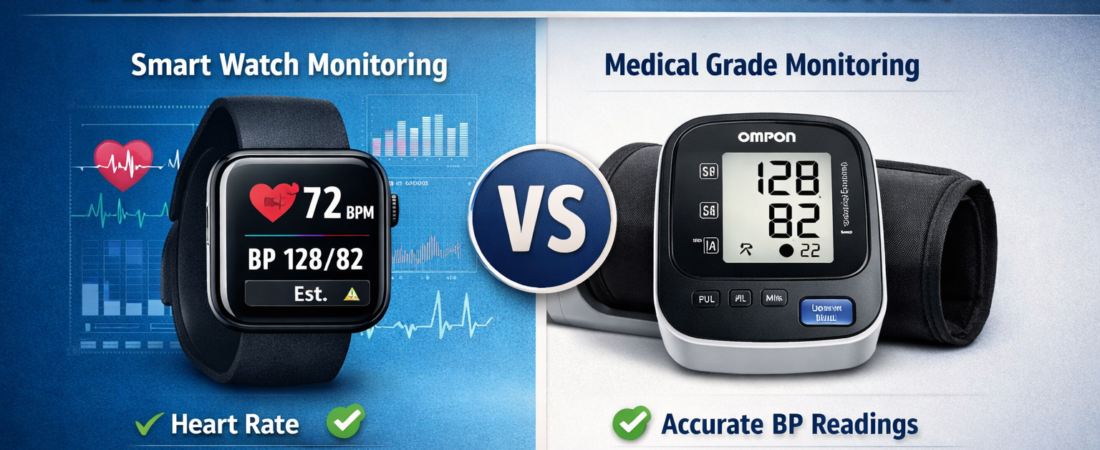
Smart watches are typically accurate for heart rate (within 1–5 beats per minute under normal conditions) but are not medically reliable for blood pressure without calibration or external cuffs.
If you’re asking how accurate are smart watches for blood pressure and heart rate? , the short answer is:
Heart rate: ✅ Generally accurate for everyday tracking
Blood pressure: ⚠️ Estimates only, not diagnostic
Best use case: Trend tracking, habit correlation, early warning signs
Not a replacement for: FDA-cleared upper-arm blood pressure watches
For people with hypertension, pre-hypertension, or family risk, smart watches are potentially powerful support tools, not standalone medical devices.
- Understanding the Question
The question how accurate are smart watches for blood pressure and heart rate? Comes up for one main reason:
People want convenience without sacrificing accuracy.
Traditional blood pressure cuffs are:
Bulky and inconvenient
Easy to misuse
Stress-inducing (hello, white coat syndrome)
Poor at showing trends over time
Smart watches promise:
24/7 monitoring
Automatic data logging
Correlation with sleep, stress, exercise, and diet
Fewer anxiety-driven readings
But does the technology live up to the promise?
Let’s break it down.
- Detailed Explanation
How Smart Watches Measure Heart Rate
Most smart watches use photoplethysmography (PPG) sensors. These shine light into your skin and detect changes in blood flow.
Accuracy factors:
Skin contact and tightness
Movement (exercise vs resting)
Skin tone and tattoos
Temperature and circulation
Bottom line:
For resting heart rate and moderate activity, smart watches are often accurate and may be comparable to chest straps.
How Smart Watches Estimate Blood Pressure
This is where things get complicated.
Most smart watches do NOT directly measure blood pressure.
Instead, they estimate BP using:
Pulse wave velocity
Heart rate variability
Algorithms trained on population data
Manual calibration with a cuff (required for some models)
Key limitation:
Blood pressure is influenced by arterial stiffness, hydration, stress, posture, and medication , variables that wrist-based sensors struggle to isolate.
Why Blood Pressure Is Harder Than Heart Rate
Heart rate is a single-variable measurement.
Blood pressure is a multi-variable physiological event.
Thats why doctors still rely on:
Upper-arm cuffs
Multiple readings over time
Clinical-grade devices
So when people ask how accurate are smart watches for blood pressure and heart rate?, the honest answer is:
Heart rate = measurement
Blood pressure = estimation
- Key Points (At a Glance)
Smart watches are often excellent for heart rate trends
Blood pressure readings are approximate, not diagnostic
Accuracy may improve with manual calibration
Movement, stress, and poor fit reduce reliability
Best results come from combining a watch with a cuff monitor
If you want clinical accuracy at home, consider pairing your smart watch with a validated upper-arm blood pressure watch for calibration and confirmation.
- Examples and Case Studies
Case Study 1: Hypertension Patient (Age 62)
Scenario:
A 62-year-old man with diagnosed hypertension uses a smart watch daily and checks BP twice a day with an arm cuff.
Results:
Watch heart rate matched cuff readings within 2–3 bpm
Blood pressure estimates were often off by 8–15 mmHg
Trends (rising BP after poor sleep) were consistent
Takeaway:
The watch helped identify patterns, not exact numbers.
Case Study 2: Fitness Enthusiast (Age 38)
Scenario:
A biohacker tracks VO2 max, HRV, and resting heart rate.
Results:
Smart watch heart rate aligned closely with chest strap
BP estimates fluctuated wildly during workouts
Resting BP trends were directionally useful
Takeaway:
Heart rate = often reliable
Blood pressure = contextual insight only
Case Study 3: Caregiver for Elderly Parent
Scenario:
A caregiver watches daily heart rate and BP trends remotely.
Results:
Heart rate alerts flagged irregular patterns early
BP still required cuff confirmation
Reduced anxiety and fewer unnecessary clinic visits
Takeaway:
Smart watches may excel as early warning systems.
- Expert Insights
Cardiologists Suggest This
Many cardiology professionals suggest:
Smart watches are not FDA-approved BP diagnostic tools
They are useful for screening and monitoring trends
They may reduce white coat syndrome by tracking passive data
According to some medical perspectives:
“Use wearables to inform decisions , not to make them.”
Thats why the best approach is hybrid monitoring.
For the most reliable setup, use a smart watch for daily trends and a clinically validated BP watch for confirmation.
FDA Clearance vs Consumer Tech
Some watches are FDA-cleared for ECG and irregular rhythm detection
Blood pressure features are typically wellness-only
Upper-arm cuffs remain the gold standard
This distinction matters when answering how accurate are smart watches for blood pressure and heart rate?
- Additional Resources
If you want deeper accuracy and better insights, consider these tools:
Recommended Monitoring Stack
Smart watch with continuous heart rate and sleep tracking
Upper-arm BP watch with memory and averaging
Mobile app that syncs both datasets
What to Look for in a BP Monitor
Upper-arm (not wrist)
Clinically validated
Multi-user memory
Bluetooth syncing
Look for blood pressure watches that sync with your phone so you can compare readings against your smart watch data easily.
- Conclusion
So , how accurate are smart watches for blood pressure and heart rate?
The finish answer:
Heart rate: Often accurate for everyday use
Blood pressure: Useful for trends, not medical decisions
Best role: Awareness, consistency, habit correlation
Worst use: Diagnosing or adjusting medication alone
For adults over 50, caregivers, and health-conscious users, smart watches may:
Reduce anxiety
Improve consistency
Reveal lifestyle triggers
Support better conversations with doctors
But they work best when paired with medical-grade tools.
If accuracy matters to you or a loved one, invest in a trusted upper-arm BP watch and use your smart watch as a powerful companion , not a replacement.
- Frequently Asked Questions
Are smart watches accurate enough for hypertension management?
They are not accurate enough alone, but may be useful when paired with a traditional BP watch.
Why do smart watch BP readings change so much?
Because they rely on algorithms influenced by movement, stress, posture, and calibration quality.
Are smart watches more accurate for heart rate than BP?
Often, yes. Heart rate accuracy is typically higher and more reliable.
Can smart watches reduce white coat syndrome?
They may. Passive, at-home tracking often produces calmer, more consistent readings.
What is the most accurate way to watch blood pressure at home?
A clinically validated upper-arm cuff, used consistently, ideally alongside a smart watch for trend analysis.
For peace of mind and better long-term tracking, choose a doctor-recommended blood pressure watch and integrate it with your wearable data.